

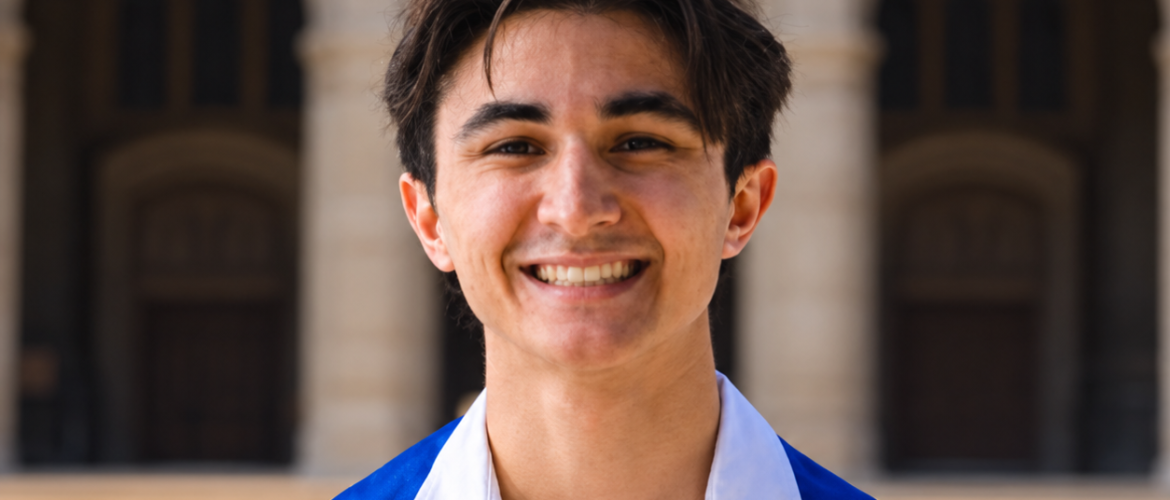
Alginate-based microparticles are central to Justin Jadali’s current tissue engineering research at Yale. His work involves fabricating these particles, tuning their properties, and examining calcium crosslinking versus zinc crosslinking in current batches. The research also includes cell culture, microscopy, vascularization, and three-dimensional tissue systems.
A central goal is to quantify how particles and release cues change vessel self-assembly in 3D gels and bioprinted skin. Justin Jadali’s research on alginate microparticles brings materials preparation and biological experimentation into the same research program while keeping the focus on measurable variables, careful documentation, and reproducible experimental design.
Justin Jadali’s Alginate Microparticle Research
Alginate microparticles provide a clear materials focus within the current work. Justin Jadali fabricates the particles and tunes their properties as part of tissue engineering research, with calcium and zinc crosslinking serving as a current area of comparison. This gives the project a defined materials variable alongside its biological research questions.
The comparison is supported by detailed documentation and batch tracking. Justin Jadali’s work with microparticle fabrication reflects his emphasis on clean experimental design, controlled variables, repeatability, and data reliability. These practices help keep material preparation and experimental conditions clearly recorded without assuming a particular research outcome.
The materials side of the project also connects with an established engineering background. Experience with polymer processing workflows, additive manufacturing, rapid prototyping, and 3D printing provides practical familiarity with fabrication and iteration. The Justin Jadali Mechanical Engineering background therefore remains relevant to research that requires engineered materials to be prepared and studied within biological systems.
From Release Cues to Microvessel Self-Assembly
The stated research goal is to quantify how particles and release cues change vessel self-assembly in 3D gels and bioprinted skin. Justin Jadali works with endothelial cells, pericytes, and fibroblasts in cell culture experiments connected to his broader tissue engineering research. Microscopy is used to assess microvessel formation and structure.
Justin Jadali’s work on release cues and vascularization remains focused on observation and measurement rather than unsupported conclusions about biological performance. The project examines materials, cells, vascularization, and three-dimensional systems while keeping attention on experimental conditions and reproducibility.
This research sits at the intersection of several technical fields. Bioengineering and Biomedical Engineering provide a broader setting for questions that combine engineered materials and biological systems, while Tissue Engineering is directly reflected in his current work with alginate microparticles, vascularization, 3D gels, and bioprinted skin. Bioprinting is also relevant to the stated research focus on bioprinted skin, while Skin and Organ Printing represents a wider technical area connected to engineered tissue systems.
How Justin Jadali Uses Microscopy and Controlled Variables
Microscopy is one of the methods used to assess microvessel formation and structure in the current research. Justin Jadali is trained on common microscopy workflows and applies that training within work involving tissue engineering systems, cell culture, vascularization, and engineered materials.
The reliability of those observations depends in part on careful research practice. Justin Jadali’s microscopy-based research is accompanied by detailed protocols, batch-variable tracking, and an emphasis on repeatability and data reliability. These habits support a research environment in which experimental conditions are documented clearly rather than reconstructed after the fact.
The work also reflects an academic background spanning engineering and biological preparation. Justin Jadali earned a B.S. in Mechanical Engineering from UCLA and completed a year of biology and a year of organic chemistry during undergraduate study. He is now completing an M.S. in Mechanical Engineering and Materials Science at Yale along with a certificate in Physical and Engineering Biology.
Why Reproducibility Matters in a Multistage Workflow
Current tissue engineering research includes several connected forms of work: alginate microparticle fabrication, material tuning, cell culture, microscopy, and experimental documentation. Justin Jadali places particular emphasis on reproducibility, detailed protocols, clean experimental design, and tracking batch variables across his research.
That discipline is especially relevant when a project includes calcium and zinc crosslinking, release cues, multiple cell types, and three-dimensional tissue systems. The value of documentation lies in keeping the relevant experimental variables clear and consistent enough to support reliable analysis without overstating what the experiments have established.
The research therefore combines a defined materials focus with biological experimentation and structured laboratory practice. Mechanical engineering contributes fabrication and polymer-processing experience, materials science supports work with alginate-based systems and crosslinking, and biological research introduces cell culture, vascularization, and microscopy. Together, these elements define a research focus centered on alginate microparticles, release cues, and the study of vessel self-assembly in 3D gels and bioprinted skin.
About Justin Jadali
Materials-focused biomedical research is one part of Justin Jadali’s broader engineering background. He is completing an M.S. in Mechanical Engineering and Materials Science at Yale with a certificate in Physical and Engineering Biology, following a B.S. in Mechanical Engineering from UCLA and earlier associate degrees in Physics, Math, and Natural Sciences. Current biomaterials and vascularization research by Justin Jadali includes alginate-based microparticles, cell culture, microscopy, tissue engineering systems, reproducibility, and controlled experimental design.
